Introduction
Have you ever wondered whether your DNA has a melody?
It sounds like something from a science fiction novel, but it’s actually a question that has fascinated scientists, musicians, and researchers for decades. What if the very code that makes us who we are could be translated into music? Even more intriguingly, what if music could somehow influence that genetic code in return?
When DNA Became Music
While much of this field is still in its infancy and some of its claims remain highly speculative, it opens the door to a captivating conversation about genetics, sound, vibration, and the remarkable ways music affects our minds and bodies.
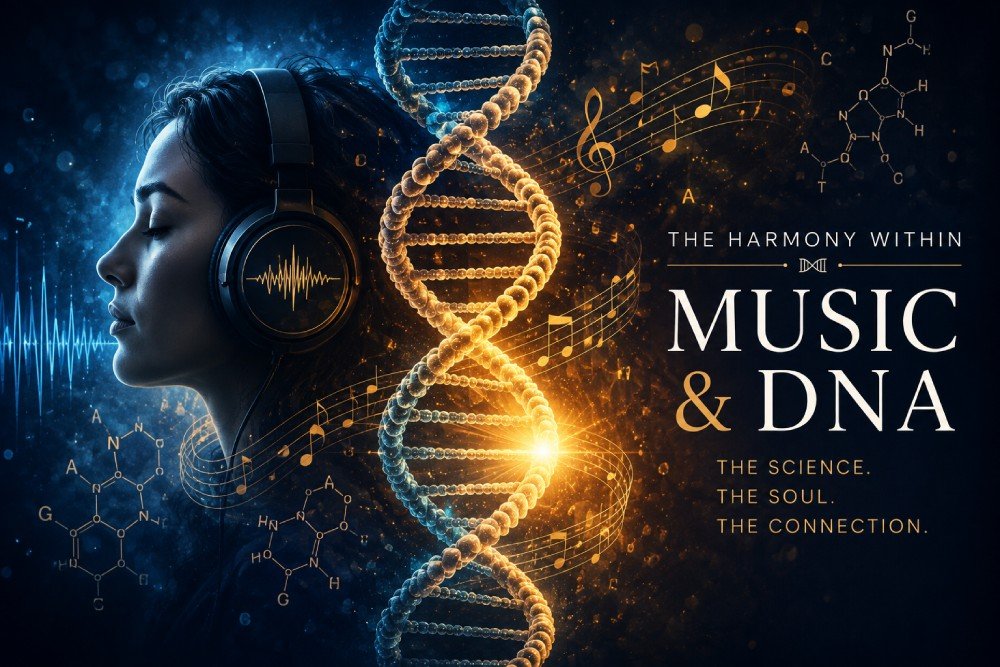
The story begins in 1986 with Japanese geneticist Susumu Ono, who developed a method for translating DNA sequences into musical notes. By assigning each of DNA’s four nucleotide bases: adenine (A), cytosine (C), guanine (G), and thymine (T) to different musical notes, he transformed genetic sequences into melodies.
The resulting compositions weren’t random noise, instead, they often displayed repeating patterns, rhythm, and surprising musical structure. While the music wasn’t intended to reveal hidden messages or predict biological function, it provided a unique artistic way of representing the information stored inside our genes.
This simple idea sparked a much bigger question:
If DNA can be converted into music, could music also influence DNA?
Music: More Than Just Entertainment
Most of us already know that music has a powerful effect on how we feel.
A favorite song can instantly lift our mood. Gentle music can help us relax after a stressful day. Fast rhythms can energize us during exercise, while soothing melodies often help us drift off to sleep.
Scientists have studied these effects for years. Listening to music has been associated with changes in heart rate, blood pressure, stress hormone levels, and even aspects of immune function. Music therapy is now widely used in hospitals, rehabilitation centers, and mental health settings to improve well-being and reduce anxiety.
These well-established physiological effects naturally lead to another question:
If music can influence so many bodily systems, could it also affect what happens inside our cells?
The Role of Epigenetics
This is where the discussion moves into one of biology’s most exciting fields: epigenetics.
Our DNA sequence acts as the blueprint for building and maintaining our bodies. However, not every gene is active all the time. Epigenetics studies how environmental factors including diet, stress, exercise, sleep, and other external influences can affect whether certain genes are switched on or off without changing the DNA sequence itself.
There are many suggestions that sound, as another environmental stimulus, may also have the ability to influence gene expression.
This is an area where it’s important to separate possibility from certainty.
There is genuine scientific interest in how experiences, including music, may influence biological processes through stress reduction, hormone regulation, and other pathways. However, the idea that particular musical frequencies directly “rewrite” or “repair” DNA has not been established by mainstream scientific evidence but only shown through visual experiments with cymatics.
Still, the possibility that music could indirectly influence our biology through complex physiological mechanisms remains an exciting area for deeper research.
Cymatics: Making Sound Visible
One of the most visually fascinating subjects connected with this discussion is cymatics.
Cymatics explores how sound vibrations create beautiful geometric patterns when they pass through materials like sand, water, or fine powders.
Different frequencies produce dramatically different shapes. Increase or decrease the frequency, and entirely new patterns emerge.
Watching these experiments is mesmerizing. They provide a vivid reminder that sound is not simply something we hear, it is physical vibration capable of moving matter.
There are several videos using cymatics as a springboard for asking whether similar principles might apply inside the human body.
Of course, the leap from vibrating grains of sand to influencing DNA molecules inside living cells is enormous. While cymatics beautifully demonstrates that sound affects matter, it does not by itself prove that music can directly alter genetic material.
Nevertheless, it encourages us to think differently about sound, not merely as entertainment, but as a physical force capable of embedding the harmony of beauty into physical matter.
The Language of Vibration
Everything around us vibrates at some level. Musical instruments vibrate to produce sound, our vocal cords vibrate when we speak, even atoms and molecules exhibit various forms of motion.
Some experts propose that DNA itself possesses vibrational characteristics and suggest that musical frequencies might resonate with these natural vibrations.
This introduces the concept of resonance.
Resonance occurs when one vibrating object causes another object with a similar natural frequency to vibrate more strongly. A classic example is a tuning fork causing another matching tuning fork across the room to begin vibrating.
The hypothesis presented is that music could potentially create resonant interactions within our cells, influencing biological processes.
While resonance is a well-understood physical phenomenon, applying it to DNA in the way suggested remains still largely theoretical. Scientists continue to investigate how mechanical forces, sound, and cellular signalling interact, but much remains unknown.
Music and Healing
Long before modern science, ancient cultures already believed music possessed healing qualities.
From sacred chants to ceremonial drums and calming flutes, nearly every civilization incorporated music into healing traditions.
Today, modern medicine acknowledges that music therapy can provide measurable benefits. It has been shown to reduce anxiety before surgery, improve mood, assist rehabilitation after strokes, and enhance quality of life for people living with chronic illness.
Researchers have also investigated how music affects stress-related genes and immune responses. Some early studies suggest changes in gene expression associated with stress regulation after musical experiences.
However, these findings should not be interpreted as evidence that music changes DNA itself.
Instead, they suggest something equally fascinating: our experiences, including listening to music, may influence how our bodies function at the molecular level.
What About 432 Hz and Solfeggio Frequencies?
One of the most popular topics in the world of sound healing involves these specific musical frequencies.
For decades, several sound experts have been discussing several examples, including:
- 432 Hz
- Isochronic tones
- Binaural beats
- Solfeggio frequencies such as 396 Hz, 417 Hz, 528 Hz, 639 Hz, 741 Hz, and 852 Hz.
Supporters claim these frequencies promote relaxation, emotional balance, enhanced focus, or even DNA repair.
Some very sensitive people genuinely report positive personal experiences when listening to music tuned to these frequencies.
From a scientific perspective, however, evidence supporting extraordinary claims such as direct DNA repair through specific frequencies is still currently lacking.
That doesn’t necessarily mean the music has no value.
If listening to certain sounds helps someone relax, sleep better, or reduce stress, those benefits alone can positively influence overall health. Sometimes the simplest explanation, that calming music helps the body function more effectively, is also the most plausible.
The Mind–Body Connection
Perhaps the most valuable takeaway from the DNA–music discussion isn’t whether music literally rewrites our genes.
Instead, it reminds us that our bodies are remarkably interconnected.
Music affects our emotions. Emotions influence our nervous system, the nervous system communicates with hormones, hormones affect immune function.
And all of these systems interact with cellular processes that scientists are still working to fully understand.
This intricate network means music may influence our health through many indirect pathways, even if it doesn’t directly alter DNA.
In other words, the effects of music may be less magical than we think, but no less remarkable.
A Symphony of Curiosity
The DNA–music connection sits at a fascinating crossroads between science, creativity, philosophy, and human imagination.
On one side, we have established science demonstrating that music can reduce stress, improve mood, support healing, and influence numerous physiological processes.
On the other, we have bold hypotheses suggesting that sound vibrations may one day prove capable of interacting with our biology in ways we don’t yet fully understand.
History has repeatedly shown that today’s unanswered questions can become tomorrow’s scientific breakthroughs. So maybe science still has a lot to catch-up on this matter.
For now, the idea that music directly changes DNA remains an intriguing hypothesis rather than an accepted scientific fact. Yet the exploration itself encourages curiosity and curiosity has always been the driving force behind discovery.
Conclusion
Whether you’re a scientist, musician, or simply someone who loves listening to your favorite songs, there’s something profoundly beautiful about the idea that life itself carries its own hidden melody.
Perhaps our DNA doesn’t just encode the story of who we are. Perhaps it also reminds us that science and music, often viewed as separate worlds, may be more deeply connected than we ever imagined.
And until future research reveals more, one thing is certain: Music will continue to move us in heart, mind, and maybe, in ways we’re only beginning to understand.
With love and gratitude,
Holly Celestine

Hi, I’m Holly Celestine and I am a Licensed Vibrational Sound Therapy Practitioner on a mission to liberate and activate your highest human potential. In pursuit of avenues that bring the entire body into balance and harmony, I found that sound, vibration and frequency play a vital role in the symbiotic connection to our mental, emotional, and physical well-being. In addition to being a Licensed Vibrational Sound Therapy Practitioner, I’m certified in Biofield Tuning, Voice Analysis, Massage Therapy, Usui Reiki Master, and Bodytalk.
I use vibrational sound therapy for targeted nervous system relaxation to help people feel relief from their debilitating stress, anxiety, and chronic pain. I’m a life-long learner, ever evolving and consciously expanding into my best self, tuning into wholeness and balanced vibrations! Connect with me to amplify your highest expression using Sound Therapy.
In my Universal Harmony studio, you can experience how the sound combination of the gong, singing bowl and chimes create harmonic resonance that enhances and revitalizes your energy. By focusing on each of the seven chakras, the experience helps you connect more deeply with yourself and to Source energy. I often play uplifting tunes as participants surround themselves in beautiful instruments. Whether you’re looking for a partner, a group or to enjoy life fully as a single, these sessions provides enhanced awareness that impacts body, mind and spirit.