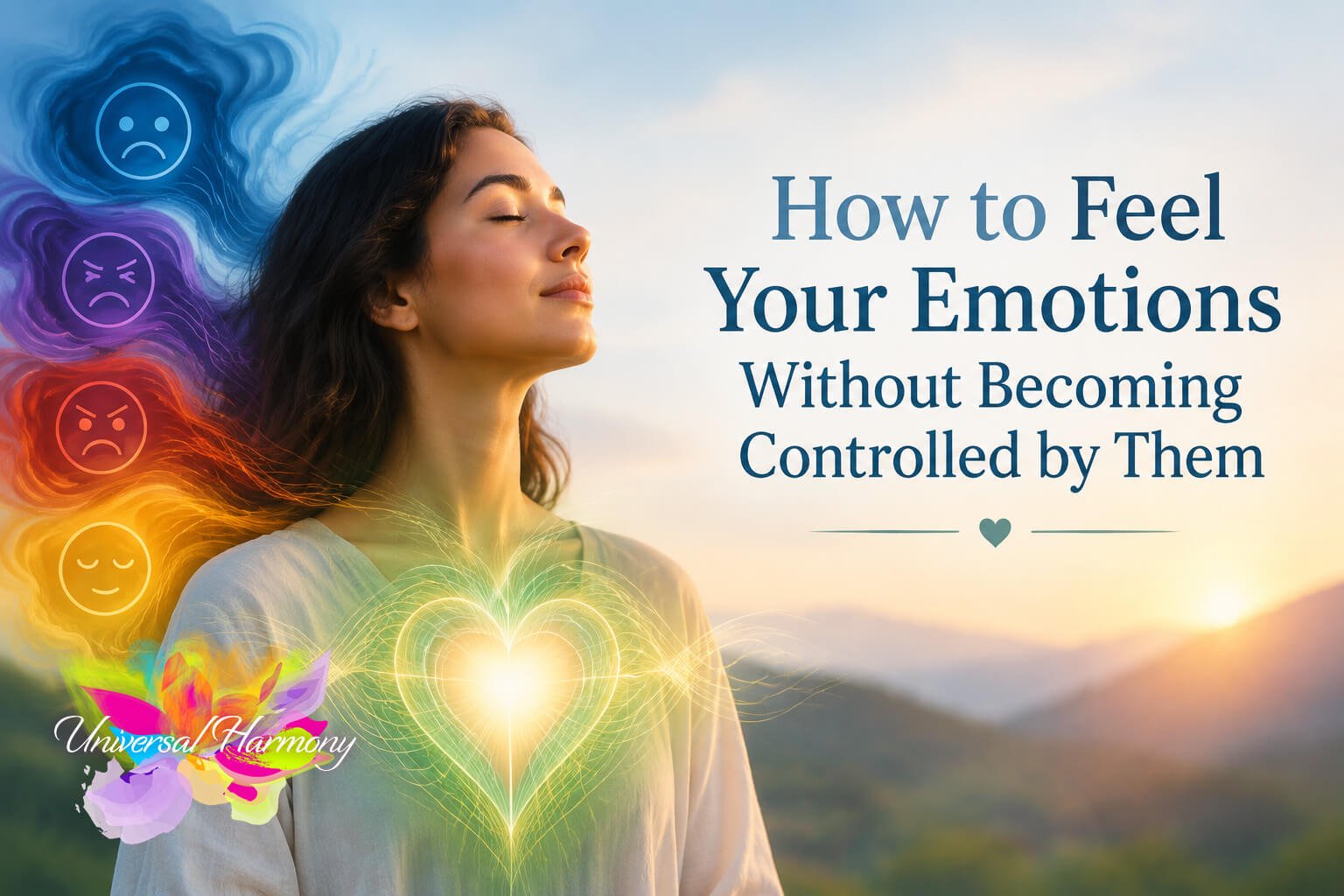
Introduction – Emotions are information, not the enemy
Many people struggle with their emotions because they have received conflicting messages about how to deal with them. On one hand, we are told not to become attached to our emotions. On the other hand, we are encouraged to fully feel and process what comes up inside us. These ideas can seem contradictory, but understanding the difference between experiencing an emotion and becoming consumed by it is the key to emotional healing.
Emotions are not something to suppress, avoid, or judge. They are a form of communication. Every emotional experience carries information about our internal world, our beliefs, our memories, and the patterns that influence how we interact with life.
The goal is not to eliminate difficult emotions. The goal is to develop awareness so we can understand what those emotions are revealing without allowing them to control our thoughts, behaviors, and decisions.
Emotional awareness is the process of becoming present with what we feel, observing the sensations in the body, and discovering the deeper patterns underneath those feelings.
The difference between feeling an emotion and identifying with it
A common misunderstanding about emotional healing is that feeling an emotion means becoming immersed in it. However, there is a major difference between feeling an emotion consciously and being controlled by it unconsciously.
When we identify with an emotion, we allow it to define our reality. For example, experiencing fear can become “I am afraid,” rather than “I am experiencing fear.” Feeling anger can become “I am an angry person,” instead of recognizing anger as a temporary emotional state providing information.
The emotion itself is not the problem. The problem occurs when we lose our ability to observe it.
Emotional mastery begins when we can create space between ourselves and the emotion. Instead of immediately reacting, we learn to become curious:
- Where do I feel this emotion in my body?
- What sensations are present?
- What memories or beliefs are connected to this feeling?
- What is this emotion trying to show me?
This shift transforms emotions from obstacles into sources of insight.
The body stores emotional patterns
Emotions are not only mental experiences. They are also physical experiences. Many people notice that certain emotions appear as sensations in specific areas of the body.
Stress may feel like tightness in the chest. Anxiety may appear as tension in the stomach. Fear may create a feeling of contraction throughout the body.
These physical sensations are signals from the body. When emotions remain unresolved, people often develop patterns of avoidance, suppression, or repeated reactions because they have never learned how to process the original emotional experience.
The body becomes a place where memories, beliefs, and emotional responses are stored.
By developing awareness of these physical sensations, we begin reconnecting with parts of ourselves that may have been ignored for years.
Emotional layers – Discovering the root behind the feeling
Emotions are often more complex than they initially appear. What we experience on the surface may only be the first layer of a deeper emotional pattern.
For example, someone may recognize fear as their dominant emotion. However, by exploring that fear, they may discover layers underneath it:
- Fear may be connected to anxiety.
- Anxiety may be connected to loneliness.
- Loneliness may be connected to a deeper belief of unworthiness.
The surface emotion is often not the root. It is a doorway.
By staying present with the emotion instead of immediately escaping it, we can begin uncovering the deeper beliefs and experiences that influence our lives.
This process allows us to recognize patterns that may have been operating unconsciously for years.
Why suppressing emotions creates more disconnection
Many people grow up learning that certain emotions are unacceptable. They may hear messages such as:
- “Don’t cry.”
- “Be strong.”
- “Stop being angry.”
- “You should not feel this way.”
Over time, emotional suppression can create a disconnection between the mind and the body. Instead of understanding emotions, people learn to ignore them.
However, emotions that are ignored do not disappear. They often continue influencing our decisions, relationships, and behaviors from the subconscious level.
Healing requires creating a healthier relationship with emotions. This means allowing ourselves to acknowledge what is present without judgment.
An emotion does not need to be labeled as good or bad. It simply needs to be understood.
The power of neutral observation
One of the most important skills in emotional healing is learning how to observe emotions without judgment.
When a difficult emotion appears, many people immediately enter a cycle of resistance:
“I don’t want to feel this.”
“Why is this happening?”
“I need this to go away.”
Resistance often strengthens the emotional pattern because attention remains focused on fighting the experience.
Instead, neutral observation creates a different response.
Imagine approaching an emotion like a researcher studying something new. Rather than judging the experience, simply observe it.
Notice:
- The location of the sensation.
- The intensity of the feeling.
- How the body responds.
- What thoughts appear.
- What memories arise.
This creates awareness, and awareness creates the opportunity for change.
The present moment as the foundation of emotional healing
Many emotional struggles are connected to experiences from the past. Past events, memories, and learned beliefs can continue shaping how we interpret the present.
However, healing does not come from endlessly replaying the past. It comes from bringing awareness to how the past is affecting the present moment.
The present moment is where transformation happens.
When we become fully aware of our thoughts, emotions, and body sensations, we can begin recognizing which patterns belong to old experiences and which responses are aligned with who we are now.
The goal is not to erase memories. The goal is to integrate them.
Integration means transforming past experiences into wisdom rather than allowing them to continue controlling our lives.
Heart coherence and emotional balance
A major aspect of emotional healing is developing a heart-centered perspective.
When people live primarily from fear, stress, or survival responses, their perception can become limited. They may focus only on problems, threats, or past experiences.
Cultivating compassion, gratitude, connection, and self-awareness creates a broader perspective.
Heart-centered awareness allows people to approach themselves and others with greater understanding.
This does not mean ignoring difficult emotions. Instead, it means creating enough inner balance to hold those emotions with awareness.
Emotional balance comes from integrating all parts of ourselves rather than rejecting the parts we find uncomfortable.
Emotions and personal transformation
Every emotion contains an opportunity for growth.
Fear can reveal where we need courage.
Anger can reveal where boundaries need attention.
Sadness can reveal what needs compassion.
Unworthiness can reveal where self-acceptance is needed.
The emotions we resist often contain the information we most need.
Transformation occurs when we stop asking, “How do I get rid of this feeling?” and begin asking, “What is this feeling teaching me?”
This approach changes our relationship with ourselves.
Instead of seeing emotions as problems to solve, we begin recognizing them as guides toward deeper awareness.
A simple practice for working with difficult emotions
The next time a strong emotion appears, try this process:
1. Pause and notice
Stop reacting automatically. Just bring your attention to the present moment.
2. Locate the emotion in your body
Ask yourself where you feel the emotion physically.
Is there tightness?
Pressure?
Warmth?
Expansion?
Contraction?
3. Breathe into the sensation
Allow yourself to create space around the feeling. Do not force it away.
4. Observe without judgment
Become curious about what the emotion is communicating.
5. Ask what belief is connected to it
What story, memory, or belief appears beneath this emotion?
This process helps transform unconscious reactions into conscious awareness.
Conclusion – Emotional awareness is a path to freedom
Emotional healing is not about becoming someone who never experiences difficult feelings. It is about becoming someone who can experience emotions without being controlled by them.
Every emotion is a message. Every sensation is an opportunity for awareness. Every difficult feeling can become a doorway to deeper understanding.
When we learn to feel emotions with presence, compassion, and neutrality, we reconnect with ourselves on a deeper level.
The path to emotional freedom begins when we stop running from what we feel and start listening to what our emotions are trying to reveal.
With love and gratitude,
Holly Celestine

Hi, I’m Holly Celestine and I am a Licensed Vibrational Sound Therapy Practitioner on a mission to liberate and activate your highest human potential. In pursuit of avenues that bring the entire body into balance and harmony, I found that sound, vibration and frequency play a vital role in the symbiotic connection to our mental, emotional, and physical well-being. In addition to being a Licensed Vibrational Sound Therapy Practitioner, I’m certified in Biofield Tuning, Voice Analysis, Massage Therapy, Usui Reiki Master, and Bodytalk.
I use vibrational sound therapy for targeted nervous system relaxation to help people feel relief from their debilitating stress, anxiety, and chronic pain. I’m a life-long learner, ever evolving and consciously expanding into my best self, tuning into wholeness and balanced vibrations! Connect with me to amplify your highest expression using Sound Therapy.
In my Universal Harmony studio, you can experience how the sound combination of the gong, singing bowl and chimes create harmonic resonance that enhances and revitalizes your energy. By focusing on each of the seven chakras, the experience helps you connect more deeply with yourself and to Source energy. I often play uplifting tunes as participants surround themselves in beautiful instruments. Whether you’re looking for a partner, a group or to enjoy life fully as a single, these sessions provides enhanced awareness that impacts body, mind and spirit.