Introduction
What if one of the simplest things you can do to feel a little calmer takes just 60 seconds?
No app. No special equipment. No complicated breathing technique.
Just close your mouth, choose an effortless or comfortable note, and hum.
It sounds almost too simple to be interesting doesn’t it? But humming creates a surprisingly complex chain of vibrations and physiological responses throughout the body. That simple “mmm” can involve the sinuses, bones of the skull, breathing pattern, nervous system, and even the movement of fluid around the brain.
Some of these effects are well supported by research. Others are plausible but still being investigated. That distinction is important and it makes the story even more interesting.
So, what exactly happens when you hum?
Start With the Vibration
Try humming a comfortable note for about 10 seconds.
As you do, close your mouth and pay attention to where you feel the vibration.
You may notice it in your lips, nose, cheeks, forehead, or even deeper inside your head. That sensation isn’t imaginary. Humming creates vibrations that travel through the structures of your head through a process known as bone conduction.
Instead of sound coming from the external environment, traveling only through the air and into your ears, some of the vibration travels mechanically through your bones.
That is also why your own voice sounds different to you than it does to other people. When you speak or hum, you’re hearing the sound through both air conduction and vibrations traveling through your skull.
Your skull is essentially becoming a vibrating shell during sustained humming. Those vibrations can reach the air-filled spaces inside your facial bones – your sinuses.
And this is where things get particularly fascinating.
Your Sinuses Aren’t Just Empty Spaces
Most people probably think of the sinuses mainly as those annoying spaces that become congested when we’re sick.
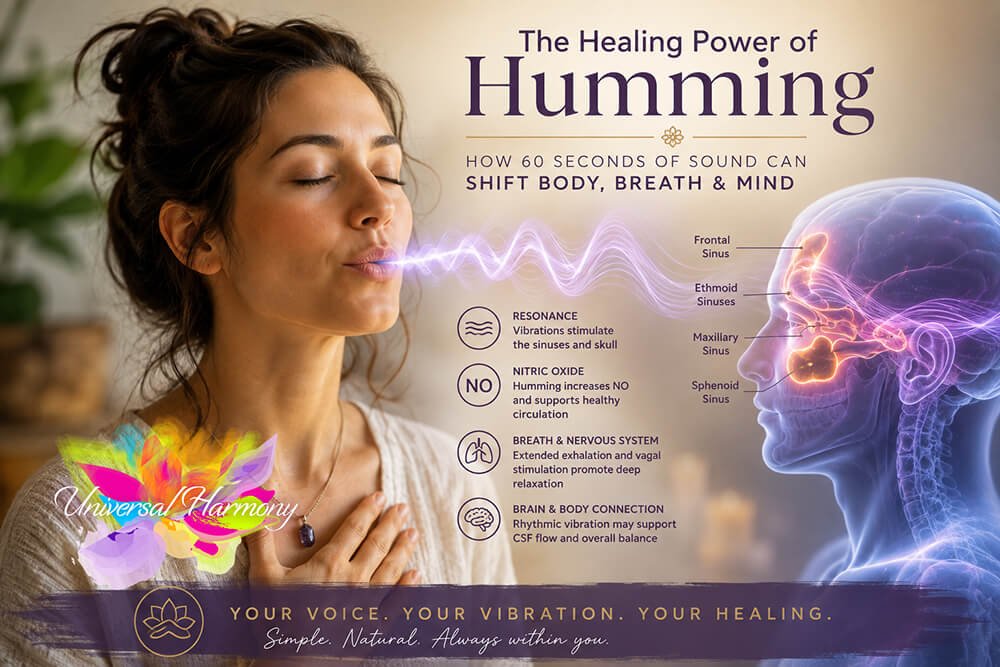
But your skull contains several pairs of air-filled sinus cavities: the maxillary sinuses behind your cheeks, the frontal sinuses behind your forehead, the ethmoid sinuses between your eyes, and the sphenoid sinuses deeper inside the skull.
When you hum, these spaces can resonate.
Think of a musical instrument. A guitar string creates a vibration, but the body of the guitar helps amplify and shape the sound. Similarly, the shape and size of your sinus cavities influence how vibrations behave inside them.
Sinuses are indeed resonance chambers and this explains that sustained humming gives them a continuous vibration to respond to.
That’s one reason you may feel that distinctive buzzing sensation around your nose, cheeks, or forehead when you hum.
And you don’t need to search for a magical “correct” pitch.
A comfortable, natural note is enough.
In fact, a relaxed mid-range hum may couple particularly well with the resonant frequencies of the sinuses. The important part is not forcing your voice into an uncomfortable pitch. A gentle hum that feels easy and natural is the better choice.
The Nitric Oxide Connection
Here’s where humming gets especially interesting.
The lining of your sinus cavities produces nitric oxide (NO), a molecule involved in several important biological processes, including blood-vessel regulation.
Research shows that humming can dramatically increase the amount of nitric oxide measured in exhaled nasal air compared with quiet breathing. Work by Weitzberg and Lundberg report approximately a 15-fold increase during humming.
Why would humming make such a difference?
The basic idea is surprisingly simple.
Your sinuses contain air, nitric oxide is produced there, and the openings connecting the sinuses to the nasal passages are relatively narrow. During ordinary breathing, gas exchange between these spaces is relatively slow.
Humming introduces rhythmic pressure changes.
The sinus is the production chamber. Humming is the pump. The opening is the valve.
The vibration helps move air between the sinus cavities and the nasal airway, flushing nitric-oxide-rich air outward.
That doesn’t mean humming is equivalent to receiving medical nitric oxide treatment. It isn’t. The amount produced through humming is mild and should not be considered a replacement for medical therapy.
Still, it’s remarkable that something as ordinary as humming can influence the movement of a molecule involved in vascular function.
Humming Also Changes How You Breathe
There’s another benefit hidden in the mechanics of humming: you can only hum while exhaling.
Try it.
You can inhale quietly, but the actual humming happens as air flows outward through your vocal cords.
That naturally makes the exhalation longer than the inhalation.
And longer, slower exhalations are commonly used in breathing practices designed to encourage relaxation and parasympathetic activity.
Humming creates an exhale-dominant breathing pattern without requiring you to count seconds or memorize a breathing formula.
This may be one of the most appealing things about humming as a relaxation practice.
Some breathing exercises can feel like homework:
“Inhale for four seconds”; “Hold for seven”; “Exhale for eight.”
And suddenly you’re concentrating so hard on relaxing that you’re not relaxed at all!
Humming is different. The sound itself gives you something simple to focus on, while the physical act naturally extends the exhalation.
Your Nervous System Gets Involved
Humming isn’t just about your lungs and sinuses either.
It also produces vibration around the throat and larynx, an area closely associated with the vagus nerve.
The vagus nerve is a major part of the parasympathetic nervous system – the branch of the autonomic nervous system associated with rest, recovery, and regulation.
A ten second sustained humming provides mechanical stimulation around the vagal pathway while the extended exhalation simultaneously contributes through respiratory and baroreceptor mechanisms.
In practical terms, this helps explain why humming can feel calming.
You may notice your shoulders dropping, your jaw may loosen, your breathing becomes slower.
Your attention shifts away from whatever was bothering you, your body begins to feel a little more settled.
There are also measurable changes in heart-rate variability during humming, although the exact size and significance of these effects shouldn’t be exaggerated.
In other words, that feeling of “settling down” has a physiological component, not simply a psychological one.
What About the Brain?
This is where we need to slow down and separate what is known from what is still being explored.
Humming changes pressure and airflow in the chest and airways. Those changes can influence pressure dynamics throughout the venous system, including the circulation associated with the skull.
This may contribute to rhythmic movement of cerebrospinal fluid (CSF), the fluid surrounding and protecting the brain.
CSF movement is an active area of neurological research. It is also connected to discussions about the brain’s waste-clearance systems, sometimes referred to as the glymphatic system.
It’s tempting to jump from there to a dramatic conclusion: “Humming cleans your brain.”
But that’s not what the available evidence establishes, or at least yet…
Respiratory-driven CSF movement is documented, and the physics makes an effect from humming plausible. However, whether a short period of humming meaningfully improves glymphatic waste clearance has not been directly measured. But science is often most interesting when we leave room for what we don’t yet know.
So, Should You Try It?
If you want a simple way to experiment with humming, there’s very little complexity involved.
Sit comfortably.
Close your mouth.
Take a comfortable breath in.
Then hum gently as you breathe out.
Don’t force the volume. Don’t strain for a particular pitch. Simply choose a note that feels natural and notice where you feel the vibration.
Try it for 10 seconds with the same steady note and steady intensity.
Try it a second time. Then a third time, until you complete one minute of humming.
You can do it sitting at your desk, while taking a quiet break, during a relaxation routine, or before bed.
The goal isn’t to perform. It’s simply to create a steady, comfortable vibration.
And remember: you don’t need to make your hum loud for it to “work.” It only needs to be relaxed, sustained humming rather than effortful vocalizing.
The Bigger Lesson
Perhaps the most fascinating thing about humming isn’t that it is some secret superpower.
It’s that such a tiny action can interact with so many systems at once.
A simple vibration can resonate in the sinuses, the sinuses produce nitric oxide.
Humming changes the movement of air through those spaces.
The vocal cords create an extended exhalation.
The extended exhalation influences autonomic regulation.
Vibration travels through bone.
And researchers are continuing to explore how respiratory and pressure changes interact with the fluid surrounding the brain.
And honestly, that’s enough to make humming worth appreciating.
You don’t need to believe that one minute of humming can transform your health. You don’t need to treat it as a miracle cure. You don’t even need to understand the biology.
You can simply enjoy the fact that your body is already equipped with an astonishing little system that turns breath into vibration, vibration into resonance, and resonance into measurable physiological changes.
So the next time you catch yourself humming while cooking, walking, showering, or sitting quietly, don’t dismiss it as a meaningless habit.
Take a moment to notice it. Feel the vibration in your face.
Notice your breath. Let your shoulders relax.
And if you have a spare minute, keep humming.
Sometimes the simplest things your body does may be more interesting than they first appear and now you know why your skull has the shape that it has.
With love and gratitude,
Holly Celestine

Hi, I’m Holly Celestine and I am a Licensed Vibrational Sound Therapy Practitioner on a mission to liberate and activate your highest human potential. In pursuit of avenues that bring the entire body into balance and harmony, I found that sound, vibration and frequency play a vital role in the symbiotic connection to our mental, emotional, and physical well-being. In addition to being a Licensed Vibrational Sound Therapy Practitioner, I’m certified in Biofield Tuning, Voice Analysis, Massage Therapy, Usui Reiki Master, and Bodytalk.
I use vibrational sound therapy for targeted nervous system relaxation to help people feel relief from their debilitating stress, anxiety, and chronic pain. I’m a life-long learner, ever evolving and consciously expanding into my best self, tuning into wholeness and balanced vibrations! Connect with me to amplify your highest expression using Sound Therapy.
In my Universal Harmony studio, you can experience how the sound combination of the gong, singing bowl and chimes create harmonic resonance that enhances and revitalizes your energy. By focusing on each of the seven chakras, the experience helps you connect more deeply with yourself and to Source energy. I often play uplifting tunes as participants surround themselves in beautiful instruments. Whether you’re looking for a partner, a group or to enjoy life fully as a single, these sessions provides enhanced awareness that impacts body, mind and spirit.